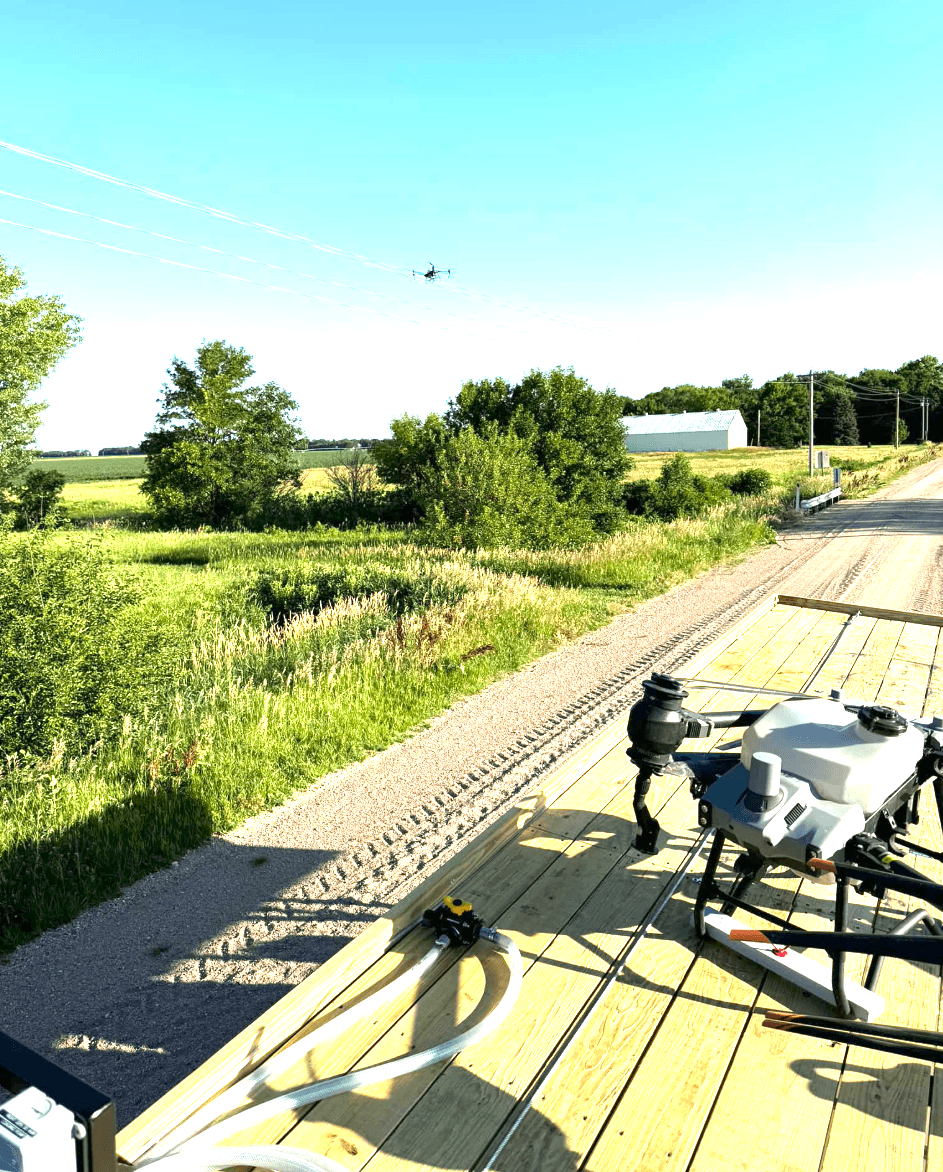
The question we get asked more than any other is the simplest one: what does it cost per acre? And right behind it: is it really cheaper than my ground rig?
There's a lot of bad math floating around on this. Some drone operators cherry-pick the savings and ignore the rate; ground equipment dealers do the reverse. Here's the honest breakdown — with every number you need to run it against your own operation.
Sticker Rate Comparison: Per-Acre Application Costs
Start with the custom application rate alone, before we get to chemical savings or hidden costs.
| Method | Typical 2026 rate in Nebraska | Practical minimum |
|---|---|---|
| Self-propelled ground sprayer (hired custom) | $8–$14/ac | $200–$400 flat floor |
| Airplane aerial application | $12–$18/ac | 40–80 acre minimum |
| Drone custom spraying | $13–$25/ac | Low / no minimum |
On rate sheet alone, the ground rig wins. That's the number drone operators don't want to lead with.
But the rate sheet is the wrong number. The total cost of getting a pound of active ingredient onto your weeds or your canopy is what matters — and that's where the math inverts.
The Line Item Most People Skip: Product Cost
Here's the part the cost-per-acre conversation usually skips. Drones apply 30–50% less product to achieve the same kill or the same coverage because of how the spray is delivered — low-volume, high-concentration, pushed into the canopy by propeller downwash.
The American Spray Drone Association reported that in 2024 alone, more than 10.3 million acres were treated with spray drones across the U.S., generating $215 million in revenue for rural service providers. Product savings across those acres averaged near 50%, resulting in an economic savings of $13.42 per acre from reduced chemical use.
Let's make that concrete. If your fungicide costs $18/ac at the label rate and a drone cuts it to $11/ac (the commonly cited 40% reduction), that's $7/ac saved on chemical. Put that savings against the application rate gap:
- Ground rig: $12/ac application + $18/ac chemical = $30/ac total
- Drone: $20/ac application + $11/ac chemical = $31/ac total
Within a dollar. And independent trials are now backing up the "no yield penalty" half of the claim — Beck's Hybrids' multi-year plot trials reported corn treated with ground rig fungicide at 15–20 gallons per acre yielding 235 bu/ac, and drone-applied at just 2 gallons per acre yielding 237 bu/ac. Essentially the same yield, one-eighth the carrier water, significantly less chemical.
That's before you account for what ground rigs cost you that isn't on the invoice.
The Costs That Don't Show Up on the Rate Sheet
There are three costs of ground application that nobody invoices you for, but they come out of your bottom line all the same.
Compaction. A loaded modern self-propelled sprayer runs 30,000–40,000 lb depending on tank size. Every pass compacts the top 8–12 inches of soil.
Wheel track damage. Iowa State and University of Wisconsin research found soybean yield losses of 2.5% with a 60-ft boom, 1.9% with a 90-ft boom, and 1.3% with a 120-ft boom — smaller than folklore suggests, but real, and more severe if you're running wheel tracks at R3 or later when the plant can't compensate. Late-season passes through a closed canopy leave a visible path of direct yield loss.
Timing. The single biggest hidden cost of ground application is the days you can't run it. Wet spring. Sidewall risk. Standing water in the low ground. Corn too tall for your clearance frame. The drone operates in every one of those conditions. If your fungicide window is 7–10 days and rain costs you 4 of them, the drone is the difference between getting it on and missing the window.
When the Rate Sheet Actually Favors the Drone
For some jobs, the drone wins on sticker price too — not just on total cost.
- Small or odd-shaped fields. A 22-acre triangle bounded by creeks is murder for a self-propelled rig; it's a 20-minute job for a drone. Custom drone spraying has no minimum on our end — we'll price a 10-acre pasture patch the same way we price a 400-acre corn field: per acre, no flat-fee penalty.
- Fields the ground rig can't reach. Wet spots, tree lines, terraces, fields surrounded by crop you don't want to drive through — all zero-cost for aerial but prohibitive for ground.
- Spot applications. If you're spraying 30 acres of pasture weeds scattered across a 400-acre rangeland, a ground rig has to cover the whole thing. A drone hits only the weeds — the application rate is the same, but the acres you're paying for drop by 80% or more.
Drone vs. Airplane: A Closer Fight
The airplane comparison is different. An aerial applicator is priced per acre in the same neighborhood as a drone ($12–$18/ac), but the minimums kill small jobs — most airplane operators won't fly for under 40 acres, and some have 80-acre floors. A 25-acre bean field that needs a tassel-stage fungicide just isn't on their route.
A drone will take that field. Drones also operate in lighter winds than airplanes (3–10 mph sweet spot vs. airplane's 3–15), and they fly 6–10 feet above the canopy, which cuts drift and improves canopy penetration.
Where the airplane still wins: raw acres per day. A Thrush or Air Tractor can cover 2,000+ acres in a day with the right ground support; a single drone is closer to 200–400. For a giant seed-corn operation that needs to get fungicide on 5,000 acres in 48 hours, the airplane is still the right tool.
Running the Math on Your Farm
Here's a short worksheet. Plug in your own numbers.
- Acres. What size is the job? Small or odd-shaped favors drone. Large and rectangular favors airplane or ground rig.
- Full-rate chemical cost per acre. Multiply by 0.6–0.7 for the drone equivalent.
- Application rate. $20/ac drone, $10/ac ground, $15/ac airplane are reasonable placeholders.
- Compaction discount. Add $1–3/ac back to the drone side if you're in no-till beans or standing corn.
- Timing penalty. If the window matters (fungicide at VT, insecticide during hatch, pre-harvest desiccation), add a "can I actually get this done in time?" check.
Nine times out of ten, a farmer who runs that math honestly finds that drone and ground rig land within a few dollars per acre total — and the drone wins on the hardest fields and tightest windows.
What We Quote at Nelson Drone
We're transparent about rates. Our agricultural spraying base rates are in the $13–$20/acre range for herbicide and fungicide, with volume discounts on jobs over 500 acres and a low minimum per trip. We don't charge extra for irregular fields, standing crops, or hard-to-access acres — that's kind of the point of a drone.
If you want to see the math on your specific operation, we'll build a side-by-side against whatever you're paying now, no charge. Give us a call at (402) 326-5811 or drop us a note through the site.