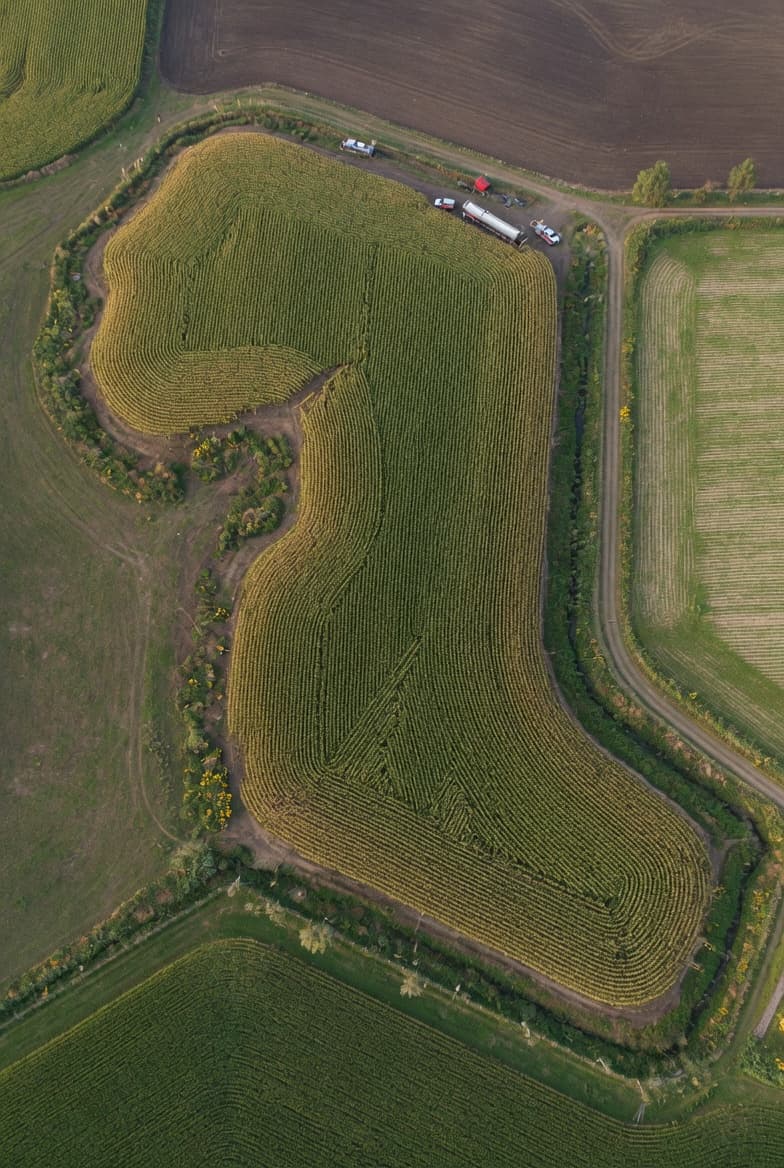
A Nebraska farmer called us last week with a problem every ground-rig operator and airplane applicator has turned down at some point: he had a 14-acre triangle of corn tucked between a creek, a shelter belt, and a county road. Pinched by terraces, too small for the airplane's minimum, too awkward for the ground rig — and the corn rootworm pressure was building fast.
That's the exact job drone application was built for.
So: what's the minimum acreage for drone spraying, and when does it actually make sense? Here's the honest answer.
The Short Version
There is no technical minimum for drone spraying. A spray drone can be in the air over a tree row, a food plot, or a 2-acre pasture patch within ten minutes of arrival on-site. The only minimum that matters is economic — the flat cost of us showing up.
At Nelson Drone, that flat floor is $400 per trip. Which works out to:
- 20 acres at a typical $20/ac application rate — that's the point where the per-acre math matches the flat floor.
- Less than 20 acres? You pay the $400 minimum. Still often worth it, for reasons we'll get to.
- More than 20 acres? Straight per-acre pricing, with volume discounts past 500 acres.
That means the smallest field worth spraying by drone — in pure efficiency terms — is right around that 20-acre mark. But pure efficiency isn't the only thing farmers are optimizing for.
Why Airplane and Ground Rig Minimums Are So Much Higher
To understand why a drone is the right answer for small fields, you have to understand why airplanes and ground rigs structurally can't serve them.
Airplane minimums exist because of how airplane economics work. An Air Tractor or Thrush needs a runway, fuel, a loader truck, and 20–30 minutes of setup time per move. Most aerial applicators in Nebraska won't load for less than 40 acres, and some have 80-acre floors. A 15-acre pasture isn't a rounding error to them — it's a money-loser.
Ground-rig minimums are softer but real. A custom self-propelled sprayer operator has to trailer a $300,000 machine, fill a 1,200-gallon tank, and burn an hour getting set up. Most will quote $200–$400 flat for the trip regardless of field size, and if the field has terraces, wet spots, or awkward geometry that forces manual driving, that number climbs fast.
A drone doesn't need a runway. It fits in a truck bed. It sets up on the tailgate. The entire operational footprint for a 10-acre job is the same as for a 500-acre job — arrive, map, mix, fly, leave. That's why the economic floor for drones is so much lower.
When a Small Drone Job Is Worth the Minimum
Let's talk about when it makes sense to pay our $400 minimum on a field smaller than 20 acres. Because it often does.
1. Tassel-stage fungicide on a 12-acre seed-corn block
Your seed-corn contract requires a VT application. Your ground rig can't get through 8-foot corn without damage, and the airplane said "call me when you've got 40 acres." That $400 for a 12-acre application is cheap insurance against a contract penalty.
2. Spot-spraying pasture weeds across a 400-acre rangeland
This one's complicated. You don't have a 400-acre spray problem — you have a 30-acre weed problem scattered across 400 acres. The problem is, as drone technology develops it will probably be possible to map out individual/patches of invasive weeds, we just aren't there yet. Your best bet is blanket-spraying the entire field to make sure all invasive species are eliminated. As drone technology evolves, the possibility of spot-spraying in a consistent and timely manner will change the game.
3. Irregular or hard-to-access acres on a larger operation
You've got a 200-acre corn field with a 6-acre wet corner that the ground rig skipped last pass, and the weeds have taken over. Or a 15-acre wedge cut off from the rest of the operation by a drainage ditch. These acres are already slowing down your main passes. Cleaning them up with a drone pass adds up to real yield recovered.
4. Food plots, orchards, and specialty crop
Hunting clubs with 3–10 acre food plots. Specialty orchards with selective-application needs. Vineyards. All of these are jobs no conventional applicator will touch at any price. A drone does them at a flat $400 and everyone goes home happy.
5. Fence lines, tree rows, and waterways
Linear weed control — invasive species along a fence or creek bank — is nearly impossible for ground rigs. A drone flies the line at the right boom height and drift is minimal. This is one of the fastest-growing uses of custom drone spraying across Nebraska.
When a Small Drone Job Doesn't Make Sense
Honesty goes both ways. There are small jobs where the math doesn't work.
- Under 3 acres of cheap chemistry. If you're spot-spraying $50 worth of glyphosate on a 2-acre patch, the $400 minimum won't pencil. A backpack sprayer or a pull-behind will do it for $20 of your time.
- Jobs you could realistically DIY. If you have a quality boom sprayer and the acres are accessible, you're not saving money hiring us to do what your equipment already handles.
- One-time small jobs with easy alternatives. Driveway weed control, garden-scale applications, and similar.
We'll tell you this upfront. If your job is too small or too simple to justify bringing a drone out, we'll say so.
The "No Hard Minimum" Reality
Here's the bottom line. Traditional aerial application has economics that force a ~40-acre floor. Traditional ground application has economics that force a $200–400 flat fee plus access and timing constraints. Drone application's floor is just the trip — everything else scales down.
That makes drone spraying the only option for a big slice of Nebraska acres: small pastures, orchards, CRP, food plots, tree rows, irregular row-crop fields, and those pinched corners every farmer has that get skipped year after year.
If you've got a "nobody else will take this job" field, that's the one we're built for. Call us at (402) 326-5811 or describe the job through the site, and we'll tell you honestly whether it's worth the trip.